Industry Insights & Articles
Technical guides, quality inspection standards, and regulatory trends in botanical extracts and nutraceuticals.

Plant Extract Application Guides
In-depth research on medicinal mushrooms, bioactive peptides, and custom dosage formulations.

Nutraceutical Ingredients Analysis
Expert perspectives on market demand, organic certifications, and bulk purchasing strategies.
Medicinal Mushroom Powder sourcing has become more complex as buyers compare extracts, whole-fruiting-body powders, and blends across a crowded supplier market. Grand View Research estimated the global medicinal mushroom market at about US$8.0 billion in 2023 and projected a 9.5% compound annual growth rate from 2024 to 2030. That figure covers the broader market, not powder alone. It signals commercial momentum, but it does not prove that every product or supplier is dependable.
A useful starting point is traceability. Ask suppliers which species they use, where the mushrooms are grown, and whether the powder comes from fruiting bodies or mycelium. Request recent certificates of analysis, including identity and contaminant testing, and check whether batches can be traced to production records. Labels can look reassuring. Documentation matters more. As mycologist Paul Stamets has said, “Mushrooms are miniature pharmaceutical factories.” The line captures their biological complexity, not a guarantee of product performance. Buyers should treat marketing claims cautiously and compare evidence, not promises.
For 2026, this guide examines suppliers through practical purchasing questions: ingredient transparency, testing, consistency, packaging, and export experience. A low price may hide gaps in documentation or uneven batches. That is easy to miss. Supplier claims also deserve independent review; even polished paperwork cannot answer every question. The aim is not to name a universal winner, but to help buyers identify a supplier that fits their product, quality requirements, and intended market.
Medicinal Mushroom Powder: Types, Forms, and Common Uses
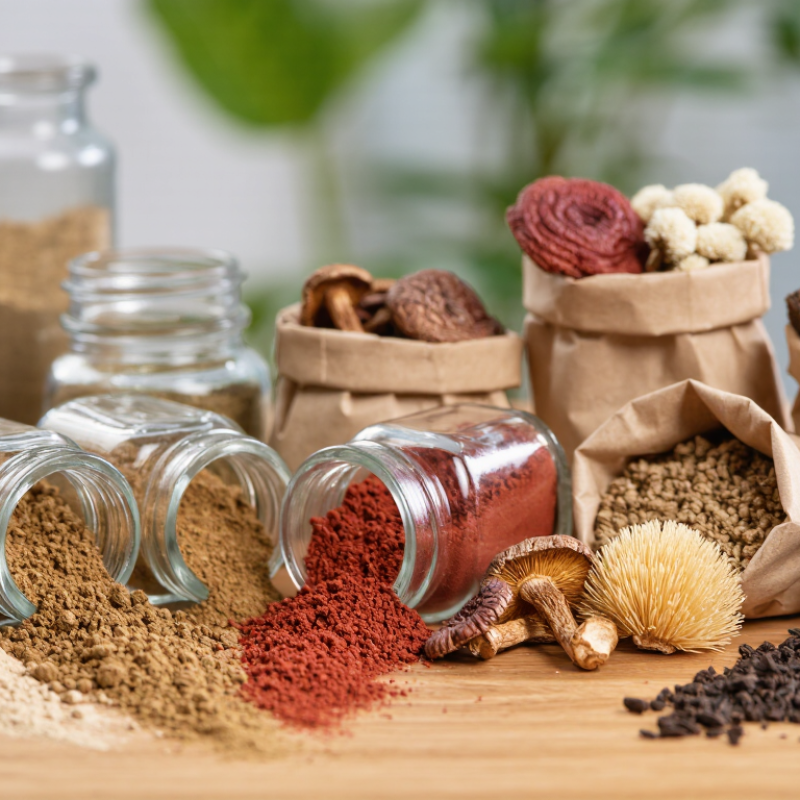
Medicinal mushroom powders vary by species, growing method, and processing. Reishi is often chosen for its earthy bitterness, while lion’s mane has a milder, slightly savory taste. Cordyceps, chaga, and turkey tail also appear in powder blends. The category is less tidy than labels suggest. Species names alone do not explain how a powder was made.
Some powders use dried, ground mushrooms; others are extracts made with water or another processing method. Products may come from fruiting bodies, mycelium, or both. These differences can affect flavor, texture, and composition. Check the ingredient list and ask suppliers for species identification and testing details. A fine powder should mix smoothly, though a little settling in hot water is normal.
People commonly stir mushroom powder into coffee, tea, smoothies, soups, or oatmeal. Reishi’s strong taste may suit cocoa or broth better than plain water. Lion’s mane can blend into a breakfast drink without much flavor change. Some buyers use powders in capsules or recipes, but heat and taste deserve consideration. Evidence for specific health benefits varies, and a powder is not a substitute for medical care. If someone takes medication or has a health condition, professional advice matters.
2026 Best Medicinal Mushroom Powder Suppliers for Buyers? — Medicinal Mushroom Powder: Types, Forms, and Common Uses
| Mushroom | Common powder forms | Common uses | Key buyer checks |
|---|---|---|---|
| Reishi (Ganoderma species) | Whole-mushroom powder; hot-water extract powder; blended extract powder | Often added to teas, cocoa, coffee blends, and capsules. Its naturally bitter taste is more suited to blends than standalone drinks. | Confirm the declared species and whether the product is whole mushroom or extract. Request testing for identity, heavy metals, microbes, and residual solvents where relevant. |
| Lion’s mane (Hericium erinaceus) | Fruiting-body powder; mycelium powder; hot-water extract powder | Used in drink mixes, capsules, and foods. It is also used as a culinary mushroom in fresh or dried forms. | Check which mushroom material is used—fruiting body, mycelium, or both—and whether any grain substrate is included in the finished powder. |
| Turkey tail (Trametes versicolor) | Whole-mushroom powder; hot-water extract powder | Commonly used in teas, powdered blends, and capsules; it is generally not selected for its flavor as a food ingredient. | Ask for species identification and clear extract details, including the extraction method and the basis for any stated concentration ratio. |
| Chaga (Inonotus obliquus) | Powdered material; hot-water extract powder | Often prepared as a tea or used in beverage blends. Chaga is a fungus associated with birch trees and is commonly sold in dried form. | Review origin and collection information, and request contaminant testing. Confirm the product’s ingredient identity and any applicable food-use or import documentation. |
| Cordyceps | Cultivated Cordyceps militaris powder; mycelium-based products; extracts | Used in powdered drink mixes, capsules, and blended products. Products may differ substantially in species and cultivation material. | Verify the Latin species name and whether the powder is fruiting body, mycelium, or a combination. Do not treat “cordyceps” as a complete species identification. |
| Maitake (Grifola frondosa) | Whole-mushroom powder; extract powder | Used as a savory food ingredient, in soups and sauces, and in capsules or mixed powders. | For food applications, assess flavor, color, particle size, and batch consistency. Request microbial and heavy-metal results for the intended market. |
| Shiitake (Lentinula edodes) | Dried whole-mushroom powder; extract powder | Commonly used as a culinary seasoning in soups, sauces, noodles, and savory blends. | Check whether the product is intended as a food ingredient or a supplement ingredient, and confirm the specifications match that use. |
| Supplier criterion | What buyers should request | Why it matters |
|---|---|---|
| Ingredient identity | Latin species name; plant-part or mushroom-material declaration; clear identification of fruiting body, mycelium, or blend | Common names alone may cover products made from different species or mushroom materials. |
| Product and extract specifications | Ingredient list, powder form, extraction method if applicable, excipients or carriers, and a defined specification sheet | These details help buyers compare products and match the ingredient to a food, beverage, or supplement application. |
| Batch testing | Current certificate of analysis (COA) for the lot, with relevant identity, microbiological, and contaminant results | Testing requirements vary by ingredient, market, and intended use. Buyers should evaluate results against applicable local limits. |
| Traceability and quality systems | Lot coding, origin and processing records, quality-system documentation, and audit information where available | Traceability supports quality investigations, recall readiness, and supply-chain review. |
| Commercial fit | Minimum order quantity, lead time, available pack sizes, shelf-life data, storage guidance, and sample availability | These terms affect production planning, landed cost, and the ability to qualify a product before purchase. |
| Claims and market compliance | Ingredient documentation and labeling information appropriate to the destination market; review all proposed claims independently | Food and supplement rules differ across markets, and product claims must comply with the applicable regulations. |
FAQS
Ask for the exact mushroom species and part, such as fruiting body or mycelium. Confirm whether the powder is raw or extracted. For extracts, request the method and clarify what any stated ratio measures. Specifications should also list particle size, moisture level, and packaging format. “Mushroom powder” alone is too vague.
Request a recent report for the same production lot you plan to buy. It should identify the species, tested material, methods, test date, and laboratory. Check results for identity, microbes, heavy metals, and relevant contaminants. Ask for units and acceptance limits. “Pass” alone is not enough.
Compare measured values with the supplier’s stated limits. Ask who sampled the lot and whether the laboratory is independent. If a method or unit is missing, request written clarification before approval. Ask for the method. A tidy report can still leave gaps.
Check the powder’s color, smell, texture, and how evenly it disperses in water. These observations may flag differences between samples and specifications. They cannot verify safety or composition. That distinction matters.
Request a chain-of-custody record linking the finished powder to its species, growing region, harvest, processing, and production lot. Compare lot numbers on the report and packaging. Save the records with purchase documents. Small detail, big gap.
Verify its scope, issuing body, and current status. A certificate may cover a facility rather than every product. It can support confidence, but it is not proof of each lot’s quality.
Compare the same data points, such as test methods, results, and acceptance limits. Ask for written explanations when answers conflict. I would not treat polished paperwork as proof by itself; records can still be incomplete.
Check that the sample and bulk packaging carry matching lot numbers. Ask how retained samples are stored, what shelf life applies, and which storage conditions are recommended. Request a documented process for reviewing each batch, since later lots may vary.
Conclusion
Choosing a reliable Medicinal Mushroom Powder supplier in 2026 starts with understanding the available mushroom species, product forms, and intended uses. Buyers should compare specifications such as species identification, ingredient composition, processing method, particle size, and packaging. Clear, consistent documentation helps confirm that a product matches the buyer’s requirements and supports informed sourcing decisions.
Supplier assessment should also consider testing practices, traceability, and relevant certifications, with attention to how quality checks are performed and recorded. Before placing an order, buyers can review product and facility documents, clarify applicable regulatory requirements for their market, request samples, and evaluate communication, production capacity, and delivery terms. A structured qualification process makes it easier to compare suppliers, identify potential gaps, and select a partner that can provide consistent products and dependable documentation.